
The European Offensive Against “Infinite Scroll”: The EU Moves Forward with the New EU Kids Act
-
DateSep 25 2026
The European Offensive Against “Infinite Scroll”: The EU Moves Forward with the New EU Kids Act
The proposal for the EU Kids Act was officially presented on September 17 by the President of the European Commission, Ursula von der Leyen, and Executive Vice-President Henna Virkkunen.
This initiative follows the report published in July 2026 by the Special Panel on Child Safety Online, with the primary objective of protecting the physical and mental well-being of minors and unifying rules across the continent.
In recent years, digital platforms have ceased to be mere spaces for social connection, evolving into highly sophisticated systems engineered to capture and monetize users’ attention.
Mechanisms such as infinite scroll, autoplay, and continuous push notifications foster compulsive usage patterns and addiction during childhood and adolescence.
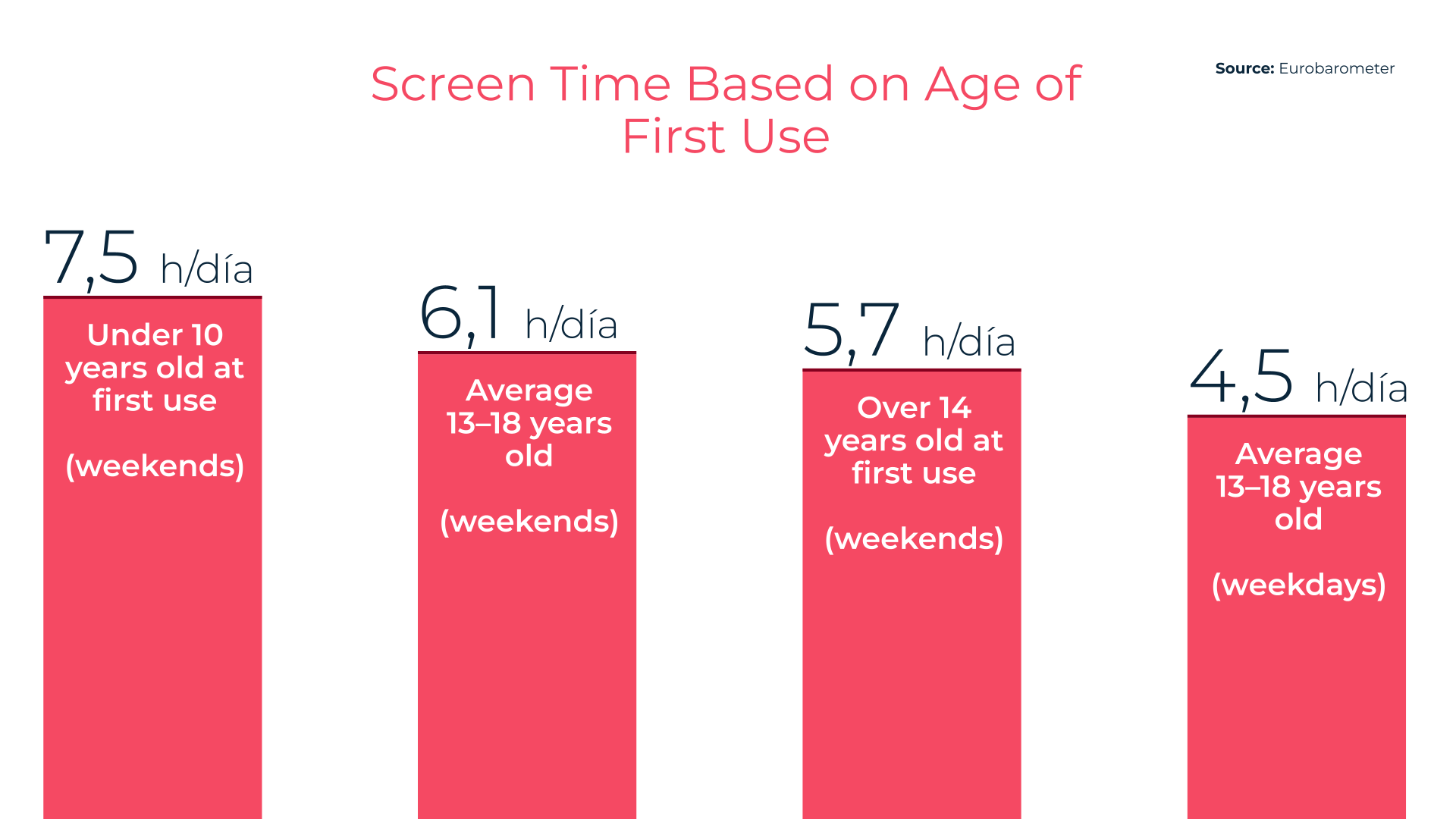
Data from the 2026 Eurobarometer survey confirm the urgent need to intervene: the age of first access to social media directly determines daily screen time.
While teenagers between the ages of 13 and 18 spend an average of 4.5 hours a day on school days and 6.1 hours on weekends, children who opened their first account before age 10 reach up to 7.5 hours daily on weekends, compared to 5.7 hours for those who started after age 14.
Key Provisions of the EU Kids Act: Core Measures and New Rules
To curb these dynamics, the law establishes an automatic protection framework across platforms like TikTok, Instagram, and YouTube, as well as online video games, app stores, and AI assistants.
– Ban on personal accounts under age 13: Children aged 3 to 13 will not be permitted to hold their own accounts. They will only be allowed to use accounts managed by their parents or legal guardians and access age-appropriate content.
– “Mini accounts” for ages 13 to 15: Adolescents in this age bracket will receive restricted profiles that enforce a strict screen time limit of one hour per day, alongside restrictions on social contacts.
– “Safe by design” platforms: Behavioral profiling recommendation algorithms, infinite scroll, autoplay, and reward systems for posting are strictly prohibited.
– Real age verification without sacrificing privacy: The self-certification checkbox for birth dates is eliminated. Verification will be handled via the EU Age Verification App or the European Digital Identity Wallet using secure “Yes/No” tokens, without tracking or storing ID documents or personal data.
– Deactivation of existing accounts: Within six months of the rules taking effect, service providers must verify current users up to age 15 and deactivate accounts for anyone below that age threshold or unable to provide proof.
– Tracking and protected devices: Tracking minors’ real-time location and activating their microphone or camera without explicit consent is strictly prohibited.
– Multimillion-dollar fines for Tech Giants: The burden of proof will fall on Very Large Online Platforms (VLOPs), which must demonstrate compliance to independent auditors. Failure to comply exposes them to penalties of up to 6% of their total global annual turnover.
A Relief for the Community: How It Helps Each Group
The EU Kids Act aims to rebalance the digital ecosystem by distributing responsibility fairly:
– Parents: While the law equips families with tools to monitor usage hours, approve contacts, and report harmful content, it does not shoulder them with full responsibility.
– Educators and schools: By curbing addictive mechanics and excessive nighttime use, sleep disruption and classroom inattention are significantly reduced. Furthermore, the law complements the European Better Internet for Kids (BIK+) strategy and the Action Plan Against Cyberbullying.
– Institutions: It delivers a unified set of regulations across all 27 Member States, preventing legislative fragmentation. Currently, 23 European nations are drafting national rules—with France and Denmark imposing restrictions on minors under 15, and countries like Spain, Italy, and Poland pushing for strict age verification—contrasting with caution from states like Estonia or the Czech Republic, which prefer prioritizing digital freedom and existing data protection laws.
– Youth themselves: Young people reclaim control over their time and emotional well-being by interacting with a clean digital ecosystem, free from compulsive notifications and algorithmic recommendations engineered to hold their attention at the expense of their health.