
-
DateSep 25 2026
More and more teenagers and young adults are integrating artificial intelligence into their daily routines as an everyday tool for studying and navigating digital culture.
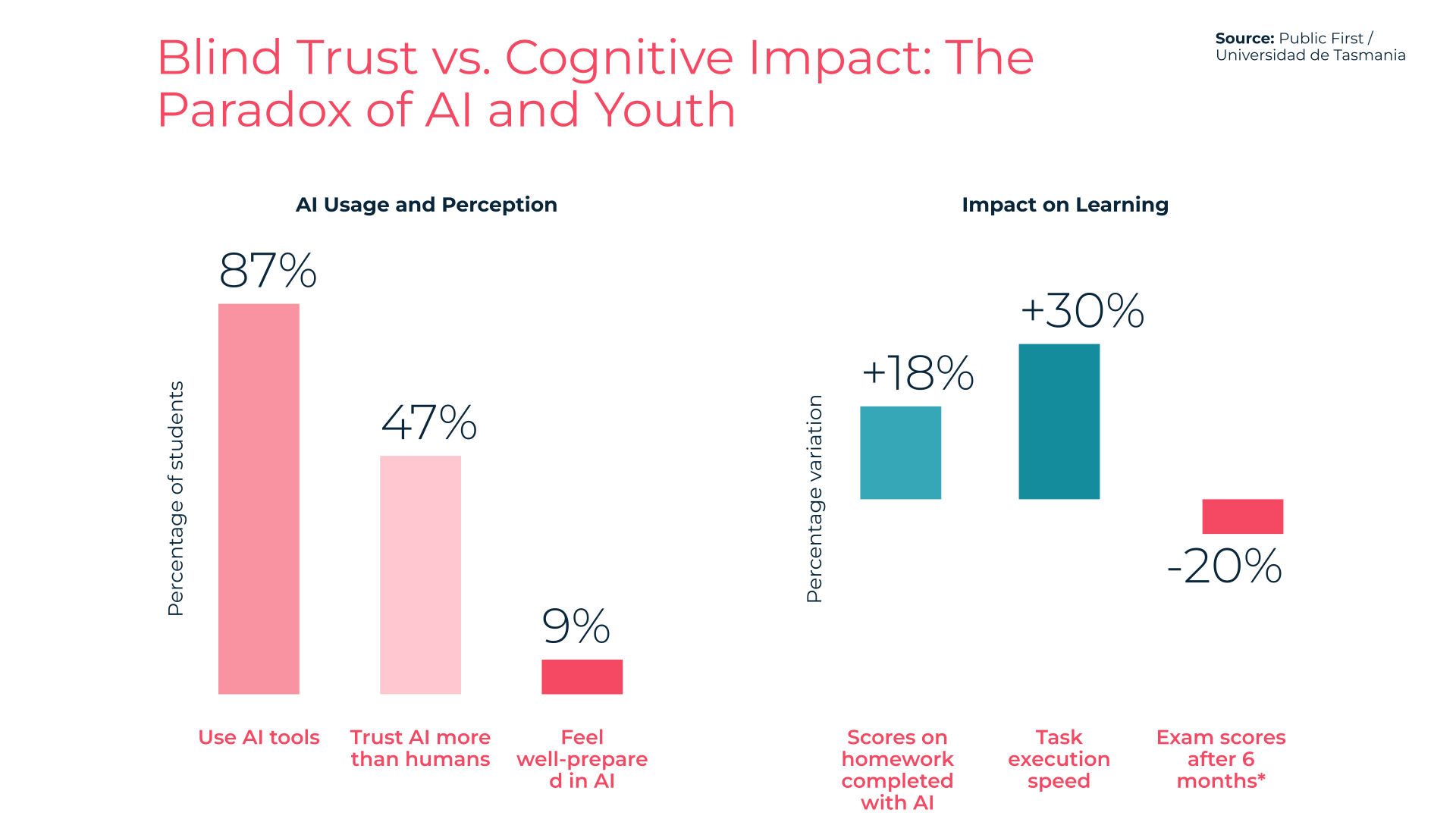
According to recent research, 87% of young people between the ages of 11 and 24 already use AI applications. However, this widespread adoption exists alongside a striking disconnect with the classroom: only 9% feel that their schools or universities are adequately preparing them to face a future dominated by this technology.
Faced with the perception that the educational system moves at a different pace than digital reality, many students demand a greater AI presence in learning and run the risk of no longer viewing school or university as a legitimate use of their time.
This gap between the classroom and the technological environment is sparking a phenomenon as silent as it is concerning: overconfidence in AI models. In the absence of clear answers and guidance within the school environment, nearly half of young people (47%) report trusting the judgment of an artificial intelligence more than that of a human being when it comes to fact-checking and verifying data.
This shift of authority toward algorithms displaces human judgment and reasoning, accepting immediate answers that are not always accurate or free from bias.
The real risk of delegating critical thinking to technology isn’t just receiving inaccurate information, but the impact it has on the learning process itself. A massive study conducted with 26,000 students analyzed the effects of continuous AI use on homework tasks.
Although the tool boosted homework scores by 18% and reduced completion time by 30%, individual exam scores dropped by 20% in just six months. The paradox is clear: AI offers a mirage of immediate productivity, but it degrades memory retention and deep understanding of subjects when personal intellectual effort is bypassed.
From the field of neuroscience, the concern extends far beyond short-term academic grades. Brain health experts warn that skipping the effort of analyzing, cross-referencing, and structuring ideas directly impacts the neural plasticity of the developing brain.
The Cognitive Issue
Training deep thinking during youth is essential to building “cognitive reserve,” a network of neural connections that protects us against future decline and brain diseases. If we systematically delegate complex mental work to AI, we risk weakening our mind’s ability to solve problems independently in the future.
Fostering healthy technology use doesn’t mean turning our backs on artificial intelligence, but rather learning to coexist with it through responsibility and a critical eye. AI can be an extraordinary ally if used to stimulate learning, prompt questions, and guide us—rather than delivering ready-made answers without passing through the filter of reason.
The challenge for young people, families, and educators isn’t choosing between humans or algorithms, but educating a generation capable of using AI as a springboard to think more and better, while always remaining in the driver’s seat of critical thought.