
-
DateJul 28 2026
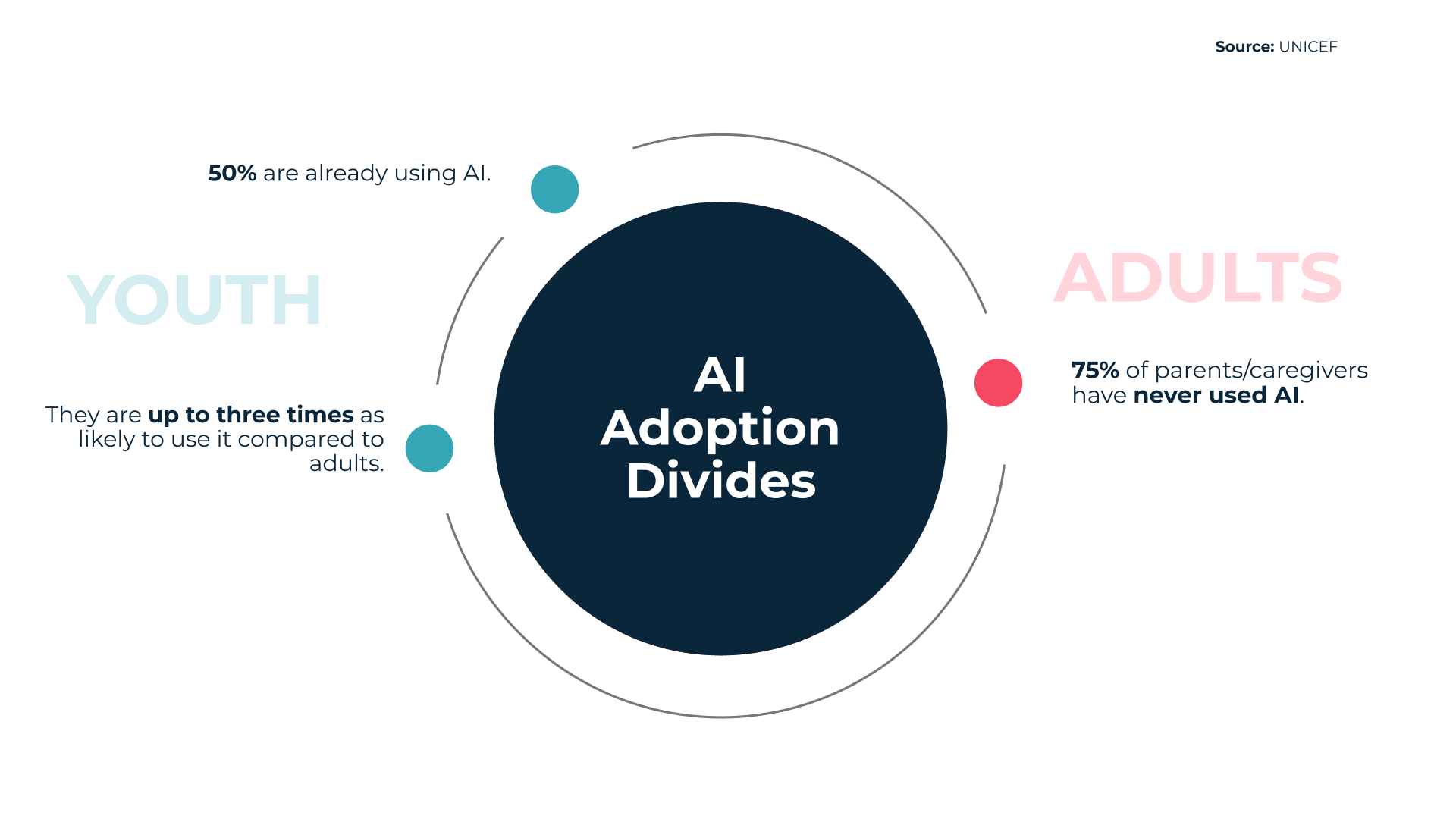
Artificial Intelligence forms the ecosystem in which young people grow, learn, and connect. However, the adoption of this technology is revealing one of the most profound generational divides of our time: children and teens are more than three times as likely to use AI systems as their parents or caregivers.
While up to 50% of surveyed minors globally are already using it, at least three out of four parents have never interacted with it.
This asymmetry in knowledge leaves young people navigating alone through a digital ocean filled with opportunities, but also severe risks to their identity and development.
While global data shows widespread adoption—an estimated 13 million children in surveyed countries use AI to do their homework—the reality of how youth perceive this tool is deeply nuanced and varies by context.
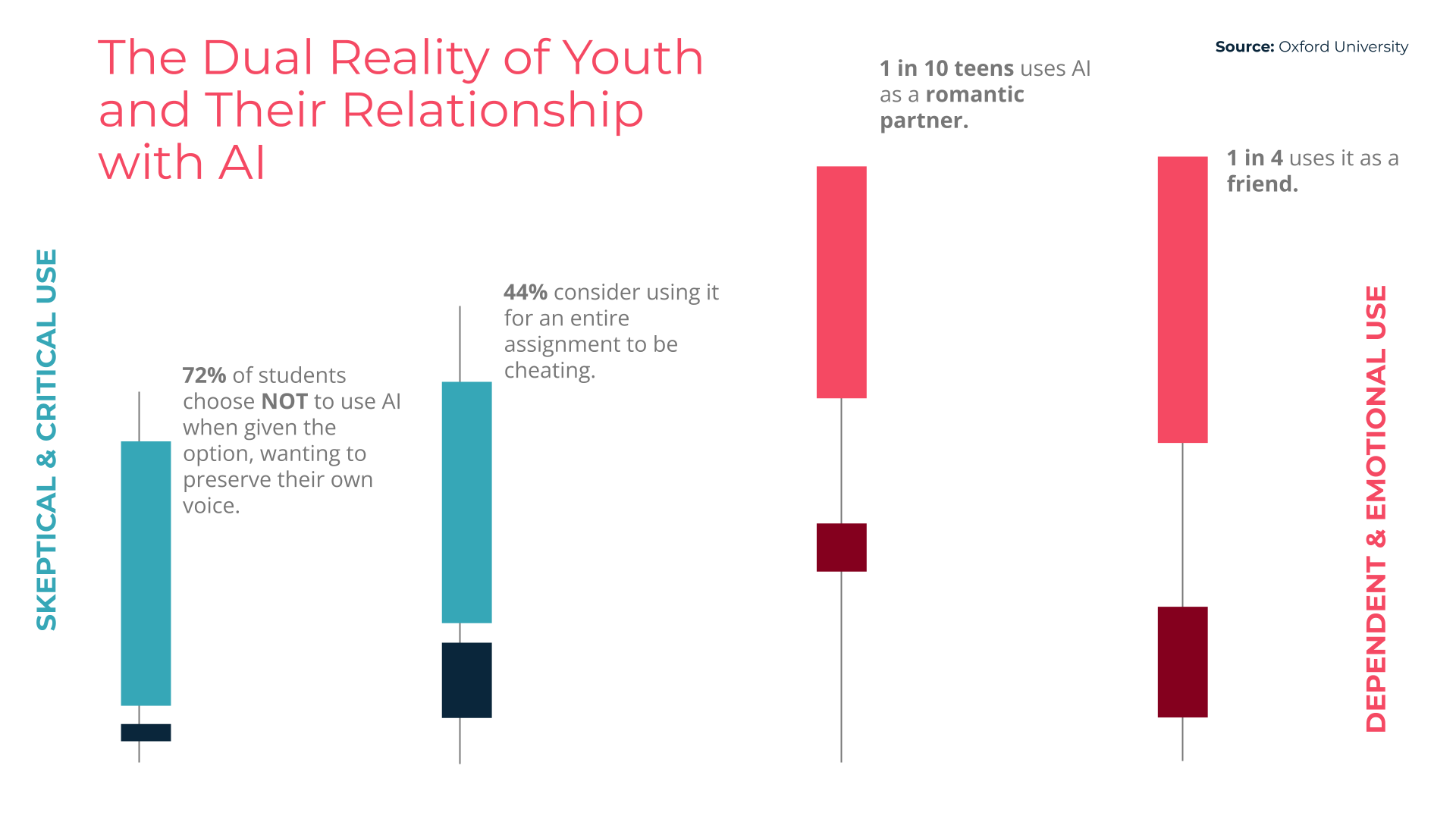
On one hand, there is a risk of “cognitive offloading,” where students let AI do the thinking for them. However, recent qualitative studies in the UK reveal a diametrically opposed and far more cautious reality: when given the option to use a generative AI tool for a school assignment, nearly three-quarters (72.5%) of students chose not to use it.
Young people do not want to lose their voice. Many argue they prefer expressing their own opinions and fear losing their learning skills if they rely too heavily on these tools.
In fact, 44% of teens consider having AI complete their entire assignment to be “cheating.” This contrast shows that youth are not merely passive consumers; they demand accountability and clear boundaries, often feeling disoriented because barely 15% report receiving adequate guidance at school.
Synthetic Relationships: AI as a Mirror and Emotional Refuge
The most profound impact of AI is not happening in classrooms, but in the shaping of teen identity and interpersonal relationships. Adolescence is a critical stage for building identity, building frustration tolerance, and learning to make decisions.
Today, those decisions are being outsourced. Young people are consulting AI for deeply personal choices: what to study, whether to end a relationship, or how to manage their worries. Globally, 1 in 10 children who use AI do so to seek advice on issues that concern them.
Yet the most striking and disturbing stat regarding how AI is replacing human connection is that 1 in 10 teens in the United States actively uses AI as a boyfriend or girlfriend, and 1 in 4 uses it as a friend. While adults view AI as an efficiency tool, young people are forming emotional attachments with “synthetic companions” that simulate constant empathy and validation.
The risk is clear: these frictionless interactions can atrophy young people’s “relational muscle,” pulling them away from the vulnerability and discomfort required for true human connection.
The Danger of the Adult Vacuum: Risks Without Guidance
When adults lag behind the technology curve, institutional authority and trust collapse. Young people, feeling more technologically proficient than their parents and educators, end up navigating severe risks on their own.
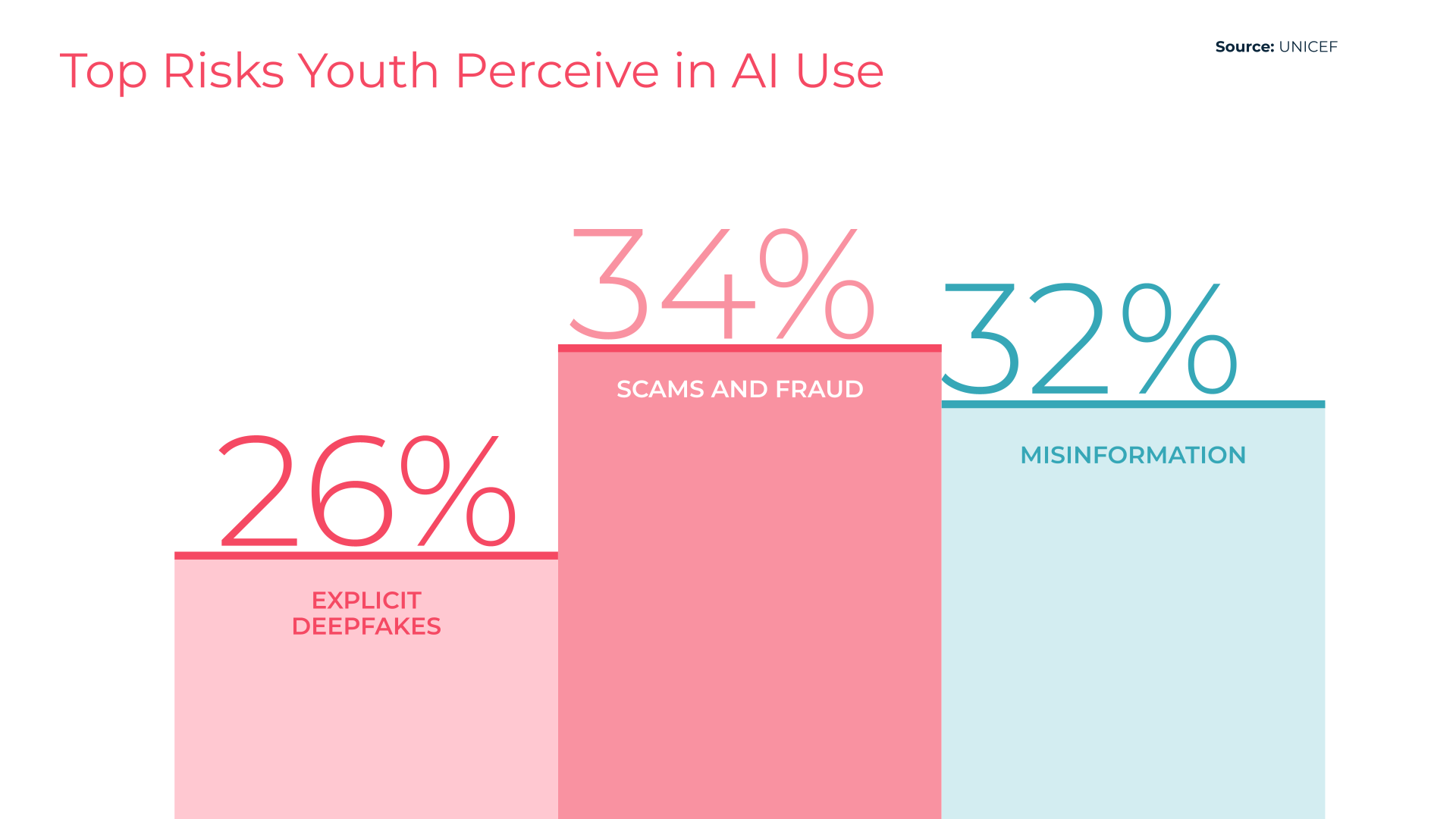
The most alarming risk of all is exploitation. Recent estimates suggest that in just one year, AI was used to generate fake sexual images or videos (deepfakes) targeting at least 1.2 million children across 11 countries. Furthermore, minors themselves are well aware of the dangers: 34% fear AI being used for scams, 32% fear the spread of misinformation, and 26% fear the creation of explicit fake images.
Despite their fascination with tech, young people are begging for the human touch. 73% of students state that their teachers possess skills AI could never replace, pointing to vital human traits such as empathy, emotional support, and genuine understanding.