
-
DateOct 26 2026
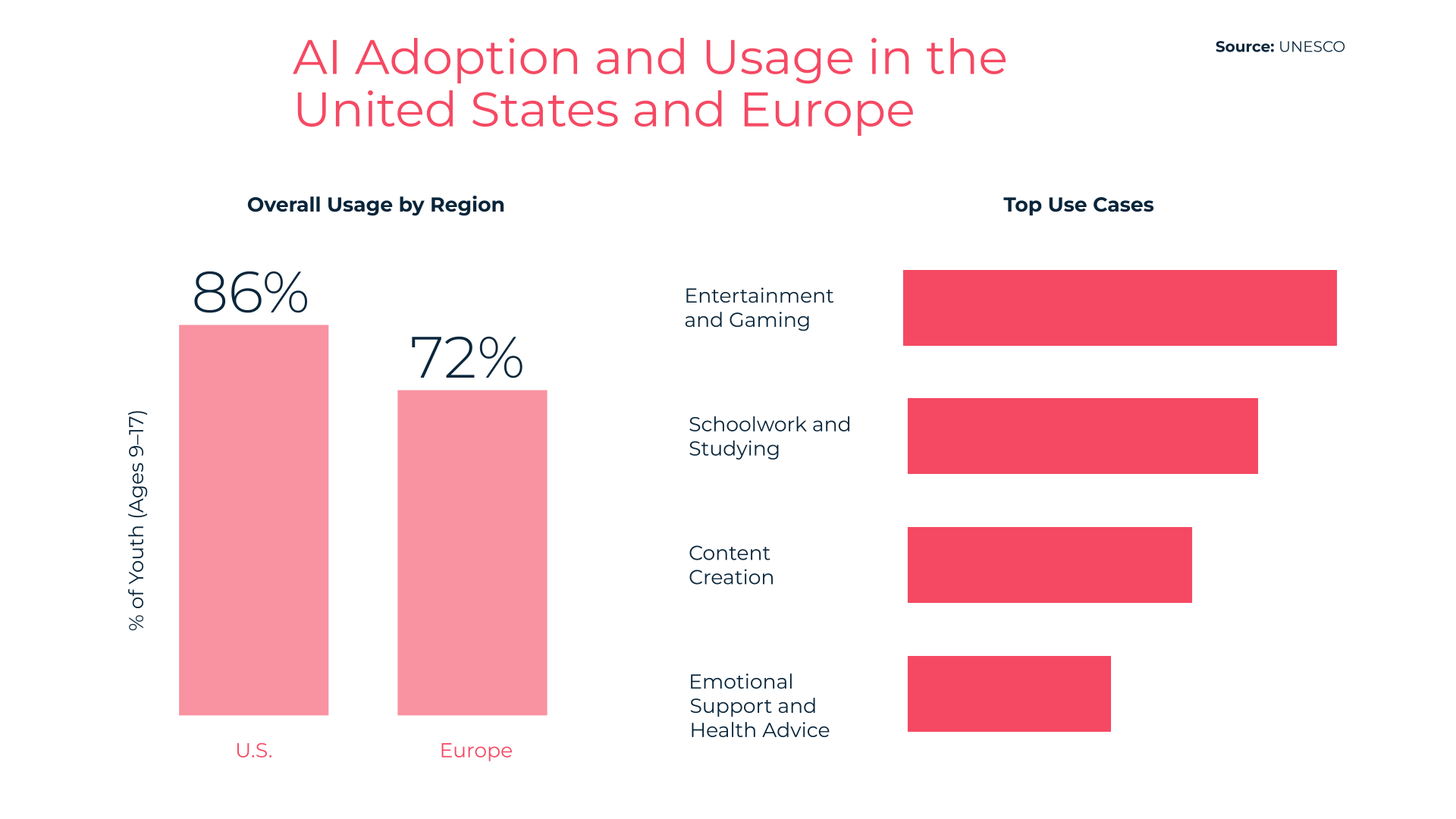
Artificial intelligence has swept into classrooms and households at a breakneck pace. According to data from a UNESCO report, 72% of European youth (ages 9–17) and 86% of American youth are already using generative AI tools, primarily for entertainment, schoolwork support, and content creation.
In fact, children and teens often experiment with chatbots long before parents or educators even realize it or can offer guidance. Faced with this sudden reality, an inescapable question emerges: is there truly an appropriate age to introduce AI into education?
The Relativity of AI
While tech is often marketed as the ultimate silver bullet for personalized learning, UNESCO warns of critical gaps in scientific evidence. Most current studies come from the Global North and fail to evaluate long-term child development. Today, 1 in 5 national AI curricula worldwide includes early childhood or primary education. However, the report stresses that child development is non-linear: an AI tool that works wonders for a teenager might be useless, confusing, or downright harmful to a six-year-old.
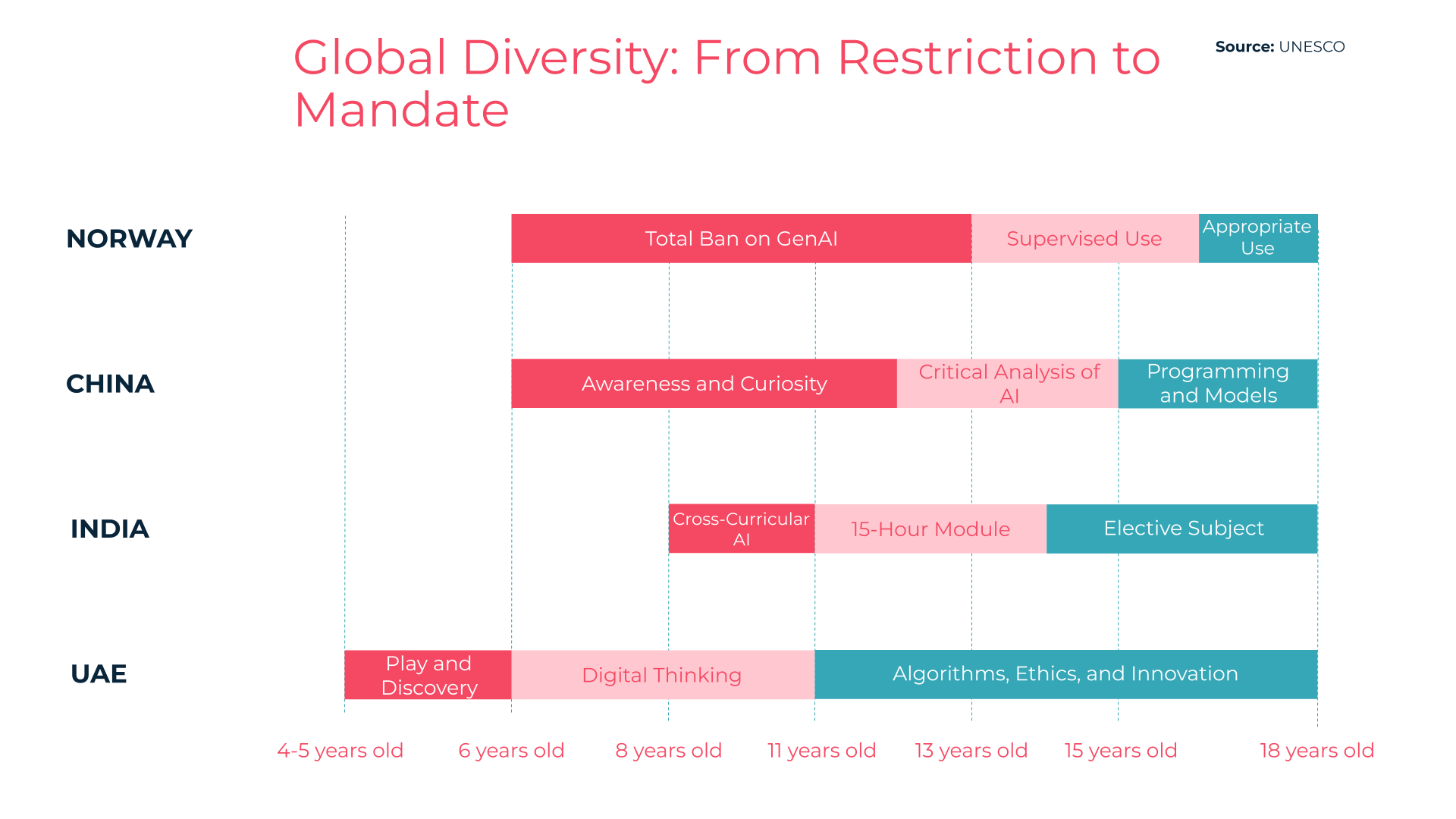
Countries are taking radically different approaches to this challenge:
- Norway has taken a maximum-precaution stance, banning generative AI in primary school (grades 1–7) and allowing it only under strict teacher supervision in secondary education.
- India, at the opposite end of the spectrum, integrates computational thinking and AI across subjects starting in the 3rd grade (ages 8–9).
- The United Arab Emirates has made it a mandatory subject starting in preschool (ages 4–5).
- China uses a step-by-step progressive model: encouraging curiosity and foundational awareness in elementary school (no unmonitored open-ended generation), critical analysis in middle school, and programming and model design in high school.
Dangerous Liaisons
Beyond regulatory disparities, the report highlights five high-priority risks that require constant oversight:
-
Data privacy and algorithmic bias
-
Amplification of social inequalities
-
Cultural and linguistic exclusion
-
Socio-emotional risks
-
Cognitive offloading
This last issue is especially alarming: premature or unchecked AI use can erode students’ independent judgment and critical thinking skills. Furthermore, younger children tend to anthropomorphize AI characters and bots, developing emotional attachments that could displace real-world relationships with peers and teachers.
Staying Vigilant Without Falling Behind
What are the main takeaways for families, educators, and policymakers? UNESCO urges the adoption of the Precautionary Principle and the implementation of child rights impact assessments before deploying AI in schools.
Technology must be designed to empower and support the teacher-student relationship, never to replace it or sideline peer-to-peer collaborative learning. The solution lies neither in blanket bans nor in blind, unfiltered adoption, but in equipping students with a structured framework that moves from foundational understanding and ethical use to critical, responsible creation.