
-
DateAug 27 2026
Artificial Intelligence has entered classrooms directly and quietly, driven not by institutional mandates, but by students themselves right from their own devices.
While universities scramble to contain the fallout from auto-generated text and the educational community calls for empirical evidence on its long-term effects, teenagers have already normalized these tools as their go-to private tutors.
This bottom-up adoption is moving at a pace that far outstrips teacher training, sparking an urgent debate on how to safeguard critical thinking and a strong work ethic in a school environment that is already automating itself behind the scenes.
AI in the Backpack: The Surge of Tech Among Teens
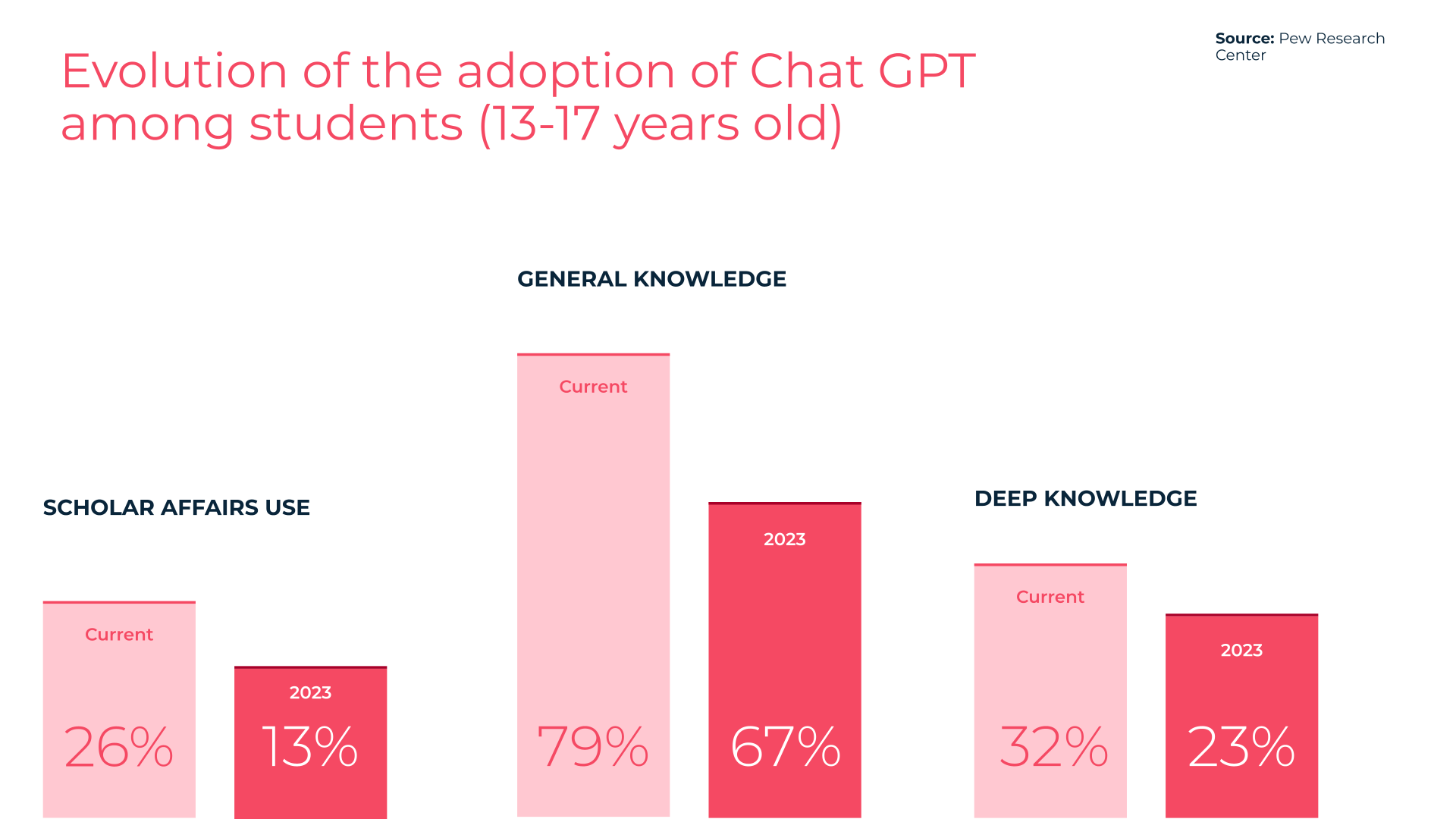
The presence of Generative AI tools in teens’ academic lives is now a firmly established trend. According to data from a Pew Research Center survey, the percentage of U.S. teens aged 13 to 17 who admit to using ChatGPT to complete their schoolwork has climbed to 26%—doubling the 13% recorded just a year earlier.
Despite this rapid surge, the vast majority of students (73%) report never having used the bot for this purpose. General awareness of the tool has also expanded substantially: 79% of teens say they have heard of the chatbot, up from 67% in the previous period.
Usage varies wildly depending on the assignment. A full 54% of teens consider using AI to research new topics acceptable, with only 9% opposing it. On the flip side, critical tasks like math problem-solving or essay writing deeply divide young opinions: only 18% approve of using it to write essays (versus 42% who reject it), while 29% view it as appropriate for math problems (versus 28% who find it unacceptable).
Spain Steps Up, but Demands Hard Data and Better Training
Spain reflects this same technological drive, but with a heavy dose of caution. According to early findings from the II Survey on Social Perception of Educational Innovation conducted by Cotec and 40db, a resounding 76% of Spain’s population believes AI should be present in schools. Yet, 72% consider it vital to see more scientific evidence regarding its actual impact on education.
When it comes to age limits, public consensus is clear: 70% of citizens believe AI should not be introduced in school before age 12, aligning with the start of compulsory secondary education.
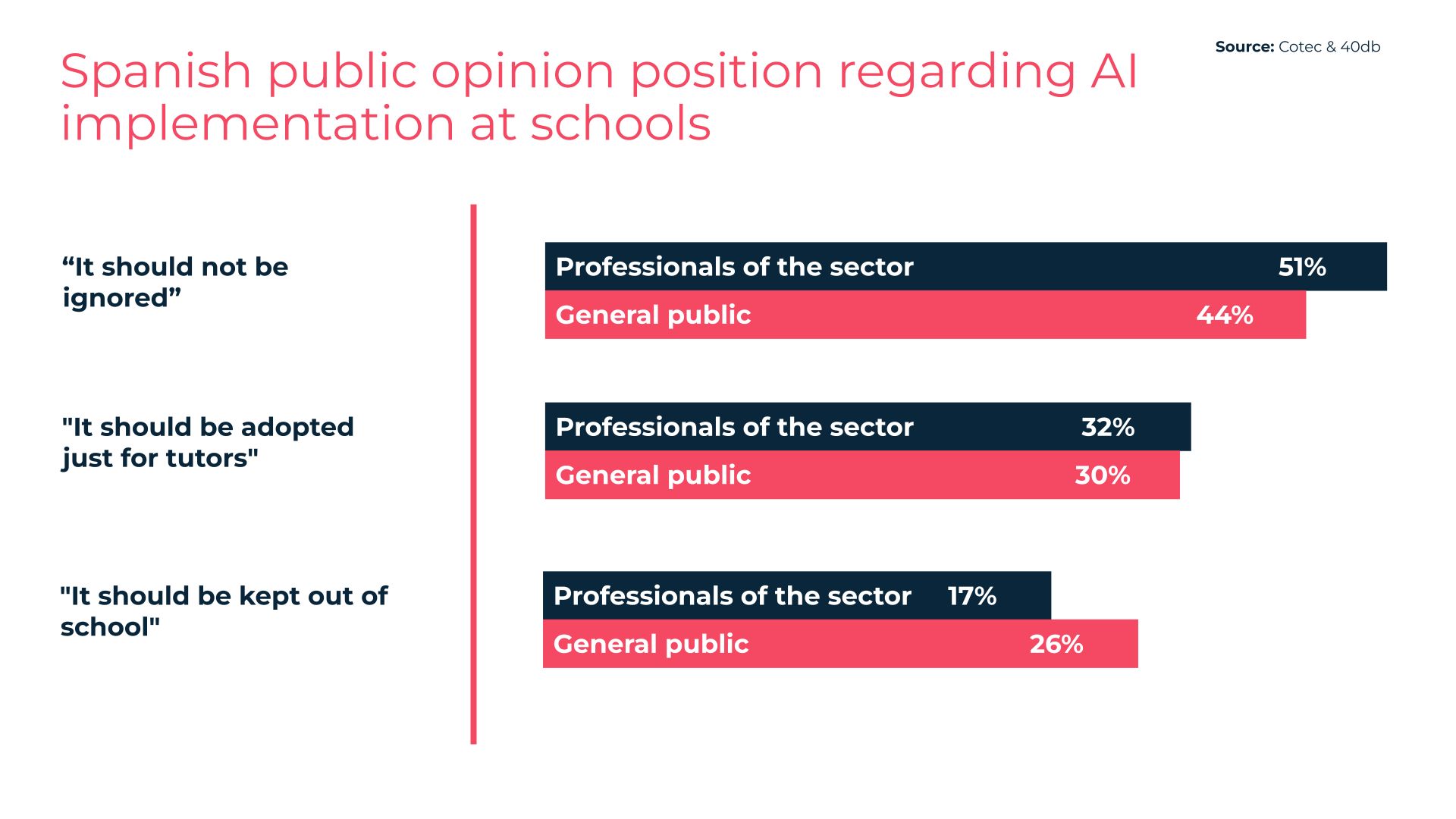
The debate isn’t just about when, but how. While 82% assign schools a lead role in teaching the ethical and responsible use of AI, 62% stress the importance of the family’s role in monitoring the digital environment.
At the same time, there is widespread concern regarding teaching capabilities: 60% of respondents believe teachers lack proper training to use this tech effectively in instruction, even as 68% (and 79% among industry professionals) perceive that AI is already being actively used in classrooms.
The Classroom Challenge: Caught Between Plagiarism Detection and Pedagogical Shifts
The rise of AI also poses major hurdles in higher education, where professors and institutions are trying to process the shift. A College Board study reveals that 72% of college faculty report facing significant or minor challenges managing student AI use.
Fields heavily reliant on out-of-class written assessments—such as literature, history, or the social sciences—experience a higher rate of incidents. In fact, 74% of college professors report that their students use AI to draft essays or papers, and 67% note its use for paraphrasing or rewriting content.
Faced with fears over plagiarism and academic dishonesty—a serious concern for 92% of instructors—nearly half of faculty members (49%) have established formal AI policies in their courses. However, only 21% of educators feel fully confident and equipped with clear strategies to guide AI use in the classroom, underscoring an urgent need for broader institutional guidance and resources.