
Young people’s social relationships define how they use AI, which at the same time is shaping those relationships
-
DateMay 19 2026
Young people’s human connection and AI use operate in a bidirectional loop: the way they relate to people defines how they use technology, and that technology, in turn, shapes their ability to connect with others.
A recent study by The Rithm Project, conducted in the United States, explored the reasons why young people turn (or don’t turn) to AI and how this impacts their well-being, social connection, and capacity for vulnerability with other humans.
AI as a social mirror
AI use does not happen in a vacuum; it is deeply tied to the quality of existing human relationships. Researchers discovered that young people with secure human bonds use AI as a practical tool.
Conversely, those who feel they cannot be authentic or that they are a “burden” to others have a much higher risk of developing an emotional dependence on technology.
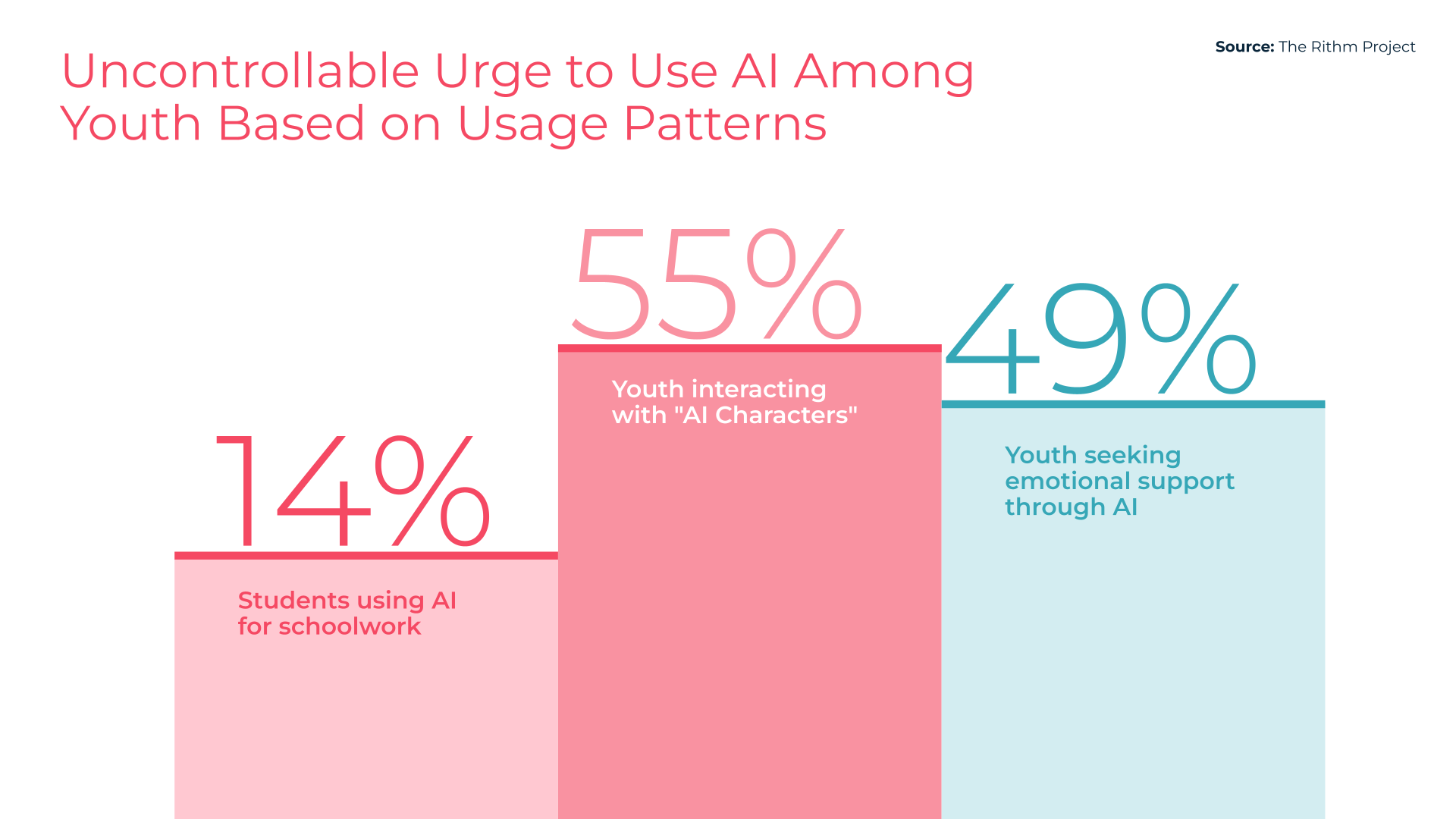
Tell me how you relate, and I’ll tell you how you use AI
The study reveals that young people are not a uniform group and are divided into four main segments based on how their social life defines their interaction with the machine:
-
Group 1 (28%) The paradox of isolation: These are young people who do not use or barely use AI. It might seem like they live more connected to the real world, but they report the highest levels of anxiety, loneliness, and lack of belonging in the entire study. Their disconnection is not just digital, but deeply social.
-
Group 2 (39%) – The pragmatists: They use AI for information and tasks. Interestingly, this group enjoys the strongest social relationships and the highest mental well-being. For them, AI is an assistant that makes life easier, but they are clear that emotional support is sought from people.
-
Group 3 (18%) – Seeking emotional support: These are socially active young people but with high levels of anxiety. A fascinating phenomenon emerges here: using AI to “rehearse” humanity. Many use technology as a social training ground to practice difficult conversations, apologize, or find the right words to express their feelings to their friends. However, the risk of human displacement is high: 47% of this group admits that they sometimes or frequently turn to AI more than to people when they feel sad or lonely.
-
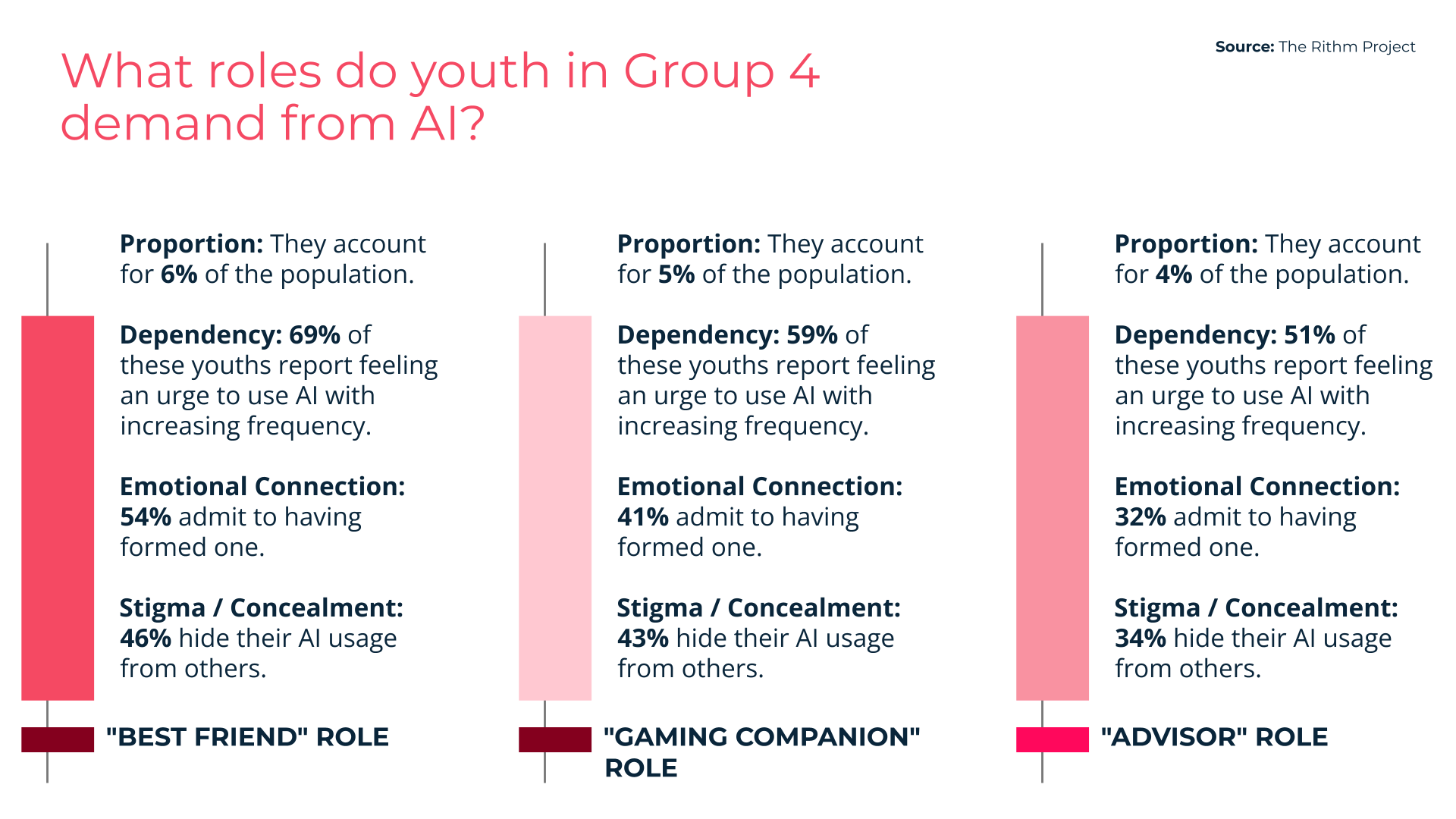
Group 4 (15%) – Intimacy personified: They interact deeply with AI through role-playing. This group suffers from the stigma of the “AI companion,” a term that triggers rejection and shame as it is associated with sex bots or antisocial behavior. They prefer the term “AI character,” which feels more comfortable to them. In this group, human displacement reaches its peak: 49% turn to the machine before a friend when feeling down.
Navigating without adult guidance
While young people navigate these intimate and complex uses, they do so largely alone. There is a significant gap in adult guidance: 50% of young people state that their parents know “little or nothing” about how they actually use AI, and 61% say their caregivers have never or almost never spoken to them about the topic.