
The “Dark” Shadow Looms Over TikTok: The Platform Hosts Thousands of Explicit Child Abuse and Child Pornography Videos
-
DateNov 25 2026
For years, the prevailing narrative placed the most severe crimes against children in the inaccessible depths of the dark web. However, an exhaustive journalistic investigation published by Maldita.es has proven that the problem is happening in broad daylight and on the favorite entertainment platform of kids and teens: TikTok.
Through weeks of tracking the social network’s algorithms, search systems, and moderation tools, the investigation exposes an ecosystem where explicit child sexual abuse material, organized communities operating with total impunity, and livestreams of minors being harassed in real time all converge while the company reaps a direct financial profit.
A Showcase in Plain Sight: Over 48 Million Views
The scale of the findings is devastating. In just 35 days of analysis, the investigative team located more than 200 profiles that had distributed 1,182 videos featuring explicit child sexual abuse, racking up over 48 million views. Far from being fleeting leaks, content was found posted for over four months, and 59% of the accounts remained fully active.
To bypass automated filters and operate as a commercial hook, distributors use everyday visual tricks: they splice frames of abuse between seemingly innocent content, overlay text, or cover areas with emojis, inviting users to reach out through external channels like Telegram or Zangi to purchase full files.
At the same time, 7,725 Spanish-language accounts were identified trading, requesting, or bragging about possessing this material in the platform’s public comments. Several of these users went so far as to admit openly or in private chats that they had homemade recordings of minors from their own family circle (children, nieces, nephews, or siblings).
When Reporting Doesn’t Work: Only 10% of Videos Are Removed
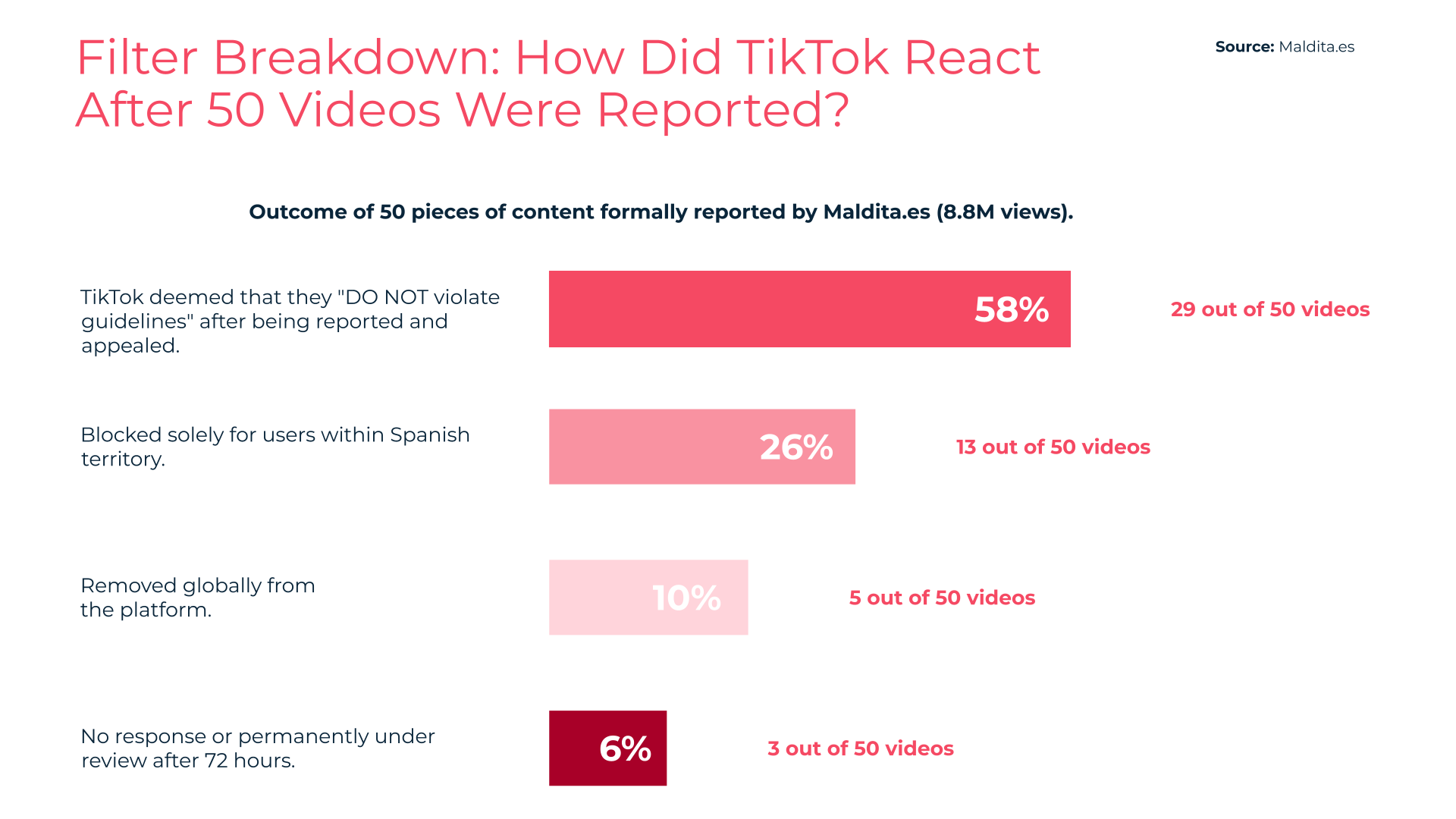
One of the most alarming points for regulators and families is the failure of TikTok’s own reporting mechanisms. As empirical proof, Maldita.es internally reported a sample of 50 videos containing explicit and illegal content that totaled 8.8 million views.
The outcome exposed a critical disconnect between the severity of the crime and the technological response: TikTok only deleted 5 videos (10%). For 58% of the complaints, the company formally replied that the footage did not violate its Community Guidelines or the law, upholding its rejection even after formal appeals were filed. Furthermore, 72 hours after being reported, 38% of the flagged accounts were still active on the network.
Right up until the report’s publication began, even the platform’s internal search engine facilitated access to these profiles through codes and terms historically linked to pedophilia that other networks ban by default, restricting them only after being confronted by the press.
TikTok Live: From the Bedroom to the Classroom, Monetized Live Harassment
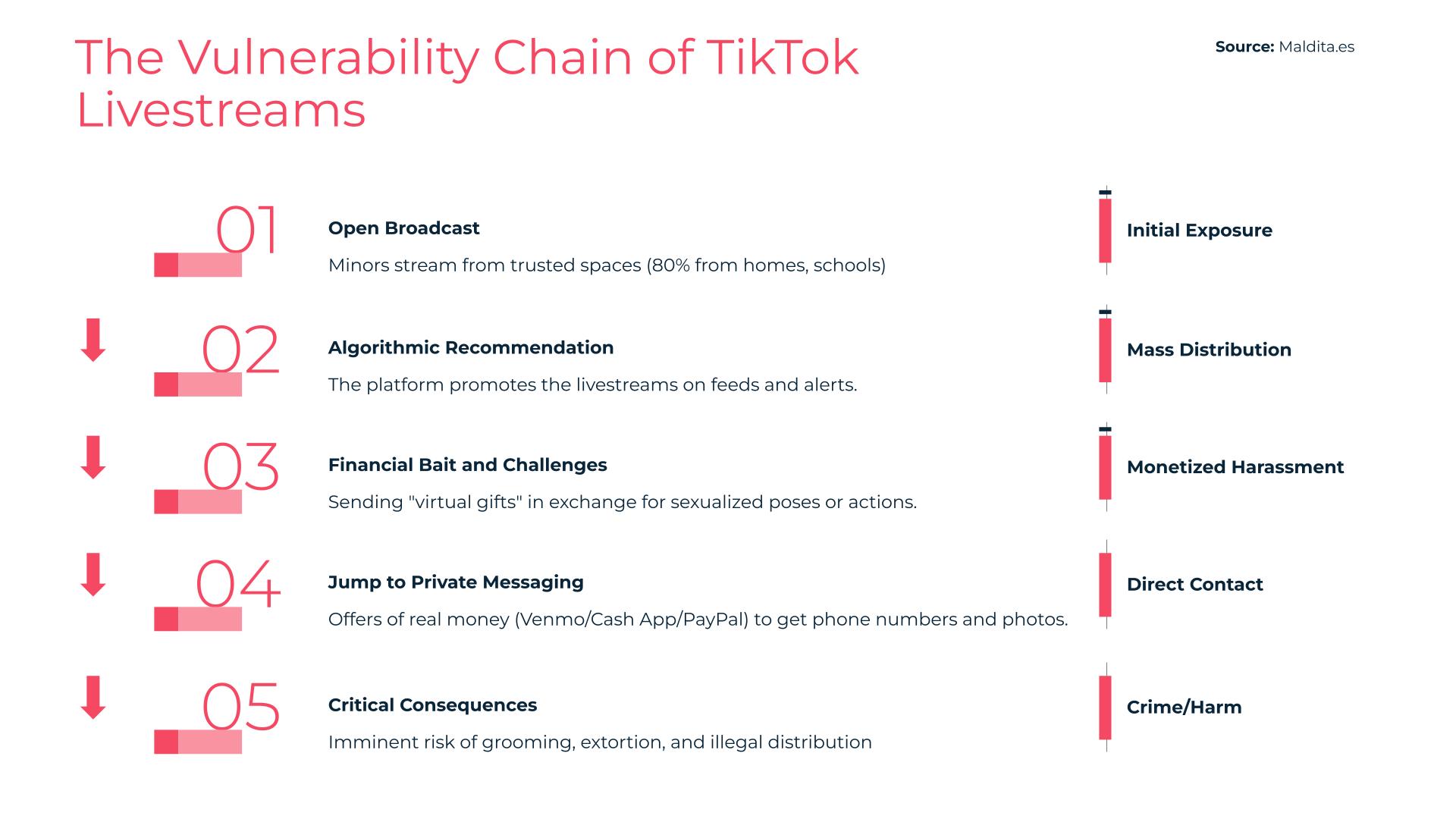
The danger is not limited to the passive consumption of stored files; it reaches peak exposure in livestreams (TikTok Live). Although the app’s rules strictly prohibit users under 18 from going live, young girls and teenage girls broadcast daily from their private bedrooms (in 4 out of 5 cases) and even from school classrooms and locker rooms.
Far from isolating these situations, the platform’s algorithm actively recommends these livestreams, suggesting up to 15 broadcasts of minors in schools across Spain in a single morning.
During these broadcasts, pedophiles and harassers fire off hundreds of sexualizing requests—ranging from demanding dances or zooming in on specific body parts to asking to see their feet (the most frequent request, with over 800 messages detected). These demands are often disguised as “challenges” in exchange for virtual gifts (such as roses or galaxies). Each gift requires the viewer to buy digital coins from the platform, cementing a scheme in which TikTok collects a direct financial commission on transactions generated around the harassment.
The Major Challenges: Caught Between Youth Vulnerability and Legal Accountability
Maldita.es’s findings put urgent dilemmas on the table for the digital ecosystem:
-
For young people and their families: Livestream interaction creates a dangerous illusion of control for underage girls. By receiving redeemable gifts, many normalize invasive requests believing they are acting voluntarily, blurring the line of exploitation. This environment leaves them wide open to grooming (adults building trust with minors for sexual purposes), sextortion, and capping (the recording and redistribution of their livestreams on internet forums without their consent).
-
For TikTok and regulators: The passivity of automated filters and the persistence of criminal accounts fundamentally call into question whether the platform is complying with its obligations under the European Union’s Digital Services Act (DSA). European regulations require Big Tech companies to actively assess and mitigate systemic risks to children, as well as promptly remove any illegal content.
The investigation leaves one clear conclusion: guaranteeing the safety of teenagers in digital environments cannot depend on minors’ ability to dodge risks, but rather on real regulatory enforcement over the algorithms, age-verification systems, and monetization models of major platforms.